Quick Answer: To budget for your first apartment in Dallas, TX, plan for two buckets: upfront move-in costs and recurring monthly bills. Expect to set aside roughly 2.5 to 4 times one month's rent before move-in, then plan for rent, utilities, and everyday essentials. In Dallas, a one-bedroom averaged about $1,416 a month as of July 2026.
Your first lease feels exciting until the move-in invoice lands. Learning how to budget for your first apartment in Dallas, TX means looking past the sticker rent and planning for deposits, fees, and the small stuff nobody warns you about. Serving southwest Dallas along the I-20 corridor, 4060 Preferred Place sits in one of the metro's more affordable pockets, and you can see exactly where it lands from our southwest Dallas location. This guide breaks the numbers down so your budget holds up on move-in day and every month after.
What Goes Into an Apartment Budget for First-Time Renters?
An apartment budget has two halves. First come the one-time costs you pay to get the keys: first month's rent, a security deposit, an application fee, and sometimes a move-in fee. Then come the monthly costs that repeat, like rent, electricity, water, internet, and groceries. Both halves matter for first-time renters, and skipping either one is how people get blindsided.
Upfront Apartment Expenses to Cover First
Upfront apartment expenses are the cash you need before you unpack a single box. Your first month's rent is the biggest piece. Add a security deposit, usually equal to one month's rent, which you get back if you leave the place in good shape. In Texas, landlords must return that deposit within 30 days of move-out. Application fees run $25 to $100 per person and are almost never refundable. Many communities also charge a one-time move-in or administrative fee, often $300 to $500. Pet owners budget more: a pet deposit of $200 to $500, plus monthly pet rent. Utility setup deposits can add $200 to $400 if you have limited credit history.
Recurring Monthly Expenses for an Apartment
Once you're in, the monthly expenses for an apartment take over. Rent is the anchor. Utilities in Dallas typically run $150 to $300 a month for electricity, water, internet, and gas, depending on your usage and unit size. Renters insurance is cheap and often required, usually $10 to $20 a month. Skip a car and a DART monthly pass costs $126. Groceries for one person land around $500 to $700. Build in a little for streaming, your phone, and the odd repair, and you have a realistic monthly picture instead of a guess.
How Much Should You Budget for Your First Apartment in Dallas, TX?
Budget for your first apartment in Dallas, TX by starting with what you can afford, not what you'd love. A common rule caps rent at 30% of gross income, so a $1,416 one-bedroom means earning roughly $57,000 a year. Then layer your move-in costs on top before you sign anything. Do not just ask whether you can afford the rent. Ask whether you can afford the move-in.
Here's a realistic move-in snapshot for a Dallas one-bedroom, using published 2026 figures. Amounts vary by community, so treat these as planning ranges when you compare one and two bedroom floor plans.
| Cost | What It Covers | Typical Amount |
|---|---|---|
| First month's rent | Your first month in the unit | About $1,416 |
| Security deposit | Refundable, held against damage | About one month's rent |
| Application fee | Credit and background check | $25 to $100 |
| Move-in or admin fee | One-time, usually non-refundable | $300 to $500 |
| Utility deposits | Starting electric, water, internet | $200 to $400 |
| Estimated total upfront | Cash before move-in day | About $3,500 to $6,000 |
That total lines up with a common rule of thumb: set aside 2.5 to 4 times one month's rent before you move. Where you rent changes the math. A unit in Uptown can top $2,400 a month, while southwest Dallas neighborhoods sit well below the citywide average of roughly $1,593, which is part of why the I-20 corridor draws budget-minded renters. Published averages disagree too. RentCafe pegged a Dallas one-bedroom at $1,416 in July 2026, while Zumper put the figure closer to $1,325, so confirm the real rent on the unit you want.
What Are the Essentials for an Apartment on a First Renter's Budget?
The essentials for an apartment go beyond furniture. Factor them in early as you budget for your first apartment in Dallas, TX, because these buys add up fast. You'll want a bed, basic kitchen gear, a shower curtain, cleaning supplies, and trash cans before your first night. First time renters furnishing a place from scratch often spend a few hundred dollars here, so spread these buys across your first month or two rather than loading them onto move-in week.
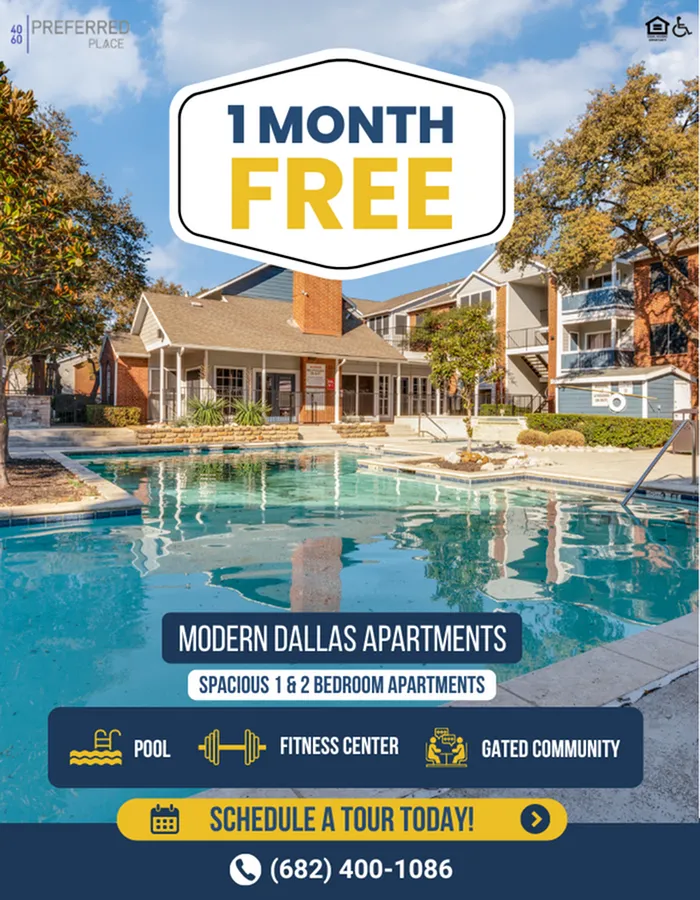
Amenities matter more than most new renters realize. A community with on-site amenities like the pool and fitness center can quietly shrink your budget, since you skip a separate gym membership and pay less to stay entertained close to home. Treat this apartment renting guide as a starting point, not a fixed rulebook, and adjust it as your income and needs change.
First Apartment Budgeting Rules to Follow
A few simple rules keep first apartment budgeting on track:
- Follow the 50/30/20 split: 50% of take-home pay for needs, 30% for wants, and 20% for savings and debt.
- Keep rent at or below 30% of gross income so one bad month doesn't sink you.
- Save one to two months of rent as an emergency cushion before you move.
- Ask every community for the full move-in cost in writing, not just the advertised rent.
For a free template, the FTC's consumer.gov offers a step-by-step budget worksheet you can use to track income against expenses. This first apartment guide works best when you write the numbers down and check them every month.
Frequently Asked Questions
1. How much money do you need to move into your first apartment in Dallas?
Plan for about 2.5 to 4 times one month's rent. For a $1,416 Dallas one-bedroom, that's roughly $3,500 to $6,000, covering first month's rent, a security deposit, application and move-in fees, and utility setup. Competitive communities may also ask for last month's rent upfront.
2. How much rent can I afford on my salary?
A common guideline keeps rent at or below 30% of gross monthly income. Quick targets:
- $45,000 a year supports about $1,125 in monthly rent
- $57,000 a year supports about $1,425 in monthly rent
- $66,000 a year supports about $1,650 in monthly rent
Adjust down if you carry student loans or a car payment.
3. What is the 50/30/20 budgeting rule?
The 50/30/20 rule splits take-home pay into three buckets: 50% for needs like rent and groceries, 30% for wants like dining and streaming, and 20% for savings and debt payoff. It's a quick way to check whether you can budget for your first apartment in Dallas, TX without tracking every single dollar.
4. How much are utilities for a first apartment in Dallas?
Utilities in Dallas usually run $150 to $300 a month for electricity, water, internet, and gas. Summer air conditioning pushes electric bills higher, so budget toward the top of that range from June through September. Ask the leasing office which utilities, if any, are included in your rent.
5. Is Dallas an expensive place to rent?
Dallas rent sits slightly below the national average. As of July 2026, the citywide average ran around $1,593 a month per RentCafe, though Zumper put it near $1,660. Neighborhoods vary widely. Uptown runs high, while southwest Dallas along I-20 stays more affordable for first-time renters.
Conclusion
Budget for your first apartment in Dallas, TX and the move stops feeling like a gamble. Split your planning into upfront costs and monthly bills, pad each with a cushion, and confirm every fee in writing before you sign. Southwest Dallas gives first-time renters room to breathe on price without giving up city access. When your numbers add up, start your rental application and settle into a place that fits both your life and your budget.